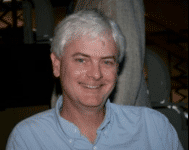
 Dr. Thomas R. Metcalf was widely respected for his work in the observation,
analysis, and interpretation of solar magnetic fields, as well as solar flare hard x-ray imaging and energetics. A patient mentor, Tom helped establish an undergraduate summer research program in Boulder, Colorado, and he expertly advised post-docs and graduate students through the years. He was a prolific researcher who has been described as “one of the nicest guys in science.” Dr. Metcalf passed away in July, 2007 at the age of 45.
In consultation with Dr. Metcalf’s family, the Solar Physics Division (SPD) has established the Thomas Metcalf SPD Travel Fund. The fund helps support newer members’ expenses for attending meetings relevant to solar physics.
2026 Thomas Metcalf SPD Travel Awards – Call for Applications from Meeting Organizers
The Solar Physics Division (SPD) hereby announces the Thomas Metcalf SPD Travel Award Program for calendar year 2026. The Thomas Metcalf Travel Fund was established in 2007 with generous contributions from his family and many others to help early-career scientists attend meetings relevant to solar physics. In 2026, in addition to two meetings already supported in early 2026, an additional two or three meetings will be selected by the Metcalf Travel Award Committee (MTAC) on the basis of brief proposals submitted by Meeting Organizers to MTAC. The total amount available this year is expected to be about USD $14,000.
Organizers of meetings worldwide relevant to solar physics that will take place before April 1, 2027, are encouraged to submit an application to Maria Kazachenko ([email protected]) for consideration by the full MTAC. Applications should be no more than three pages in length and must be received by April 1, 2026. Please check the application guidelines for additional details.
Briefly, the procedure is as follows. First, an application is submitted by Meeting Organizers to the MTAC. If selected, Meeting Organizers will then seek out qualified early-career scientists who can make a significant contribution to their meeting. Awardees (hereafter, Metcalf Lecturers) will be chosen by Meeting Organizers based on their potential for future contributions to the field of solar physics and the relevance of their work to the topic of the meeting. Prospective Metcalf Lecturers should apply directly to the Meeting Organizers and not to the MTAC. The MTAC, however, will verify the eligibility of each awardee.
Metcalf Lecturers for 2026 must have received their Ph.D. no earlier than January 1, 2022, or be a student within one year of completing their Ph.D. Awardees must be members of the SPD (affiliate membership is OK) and must not have previously served as a Metcalf Lecturer. Awardees must present their work at the meeting, and after the meeting must submit a one-page report describing their contribution. Grants are provided directly to the Metcalf Lecturers by the Treasurer of the SPD upon receipt of their report by the MTAC and copies of the receipts by the Treasurer.
For additional information about the program, please visit the program website, consult the program rules, or contact Maria Kazachenko.
Metcalf Travel Award Committee for 2026: Maria Kazachenko, Michael Kirk, Andrés Muñoz-Jaramillo, Lucas Tarr
May 2025: Metcalf Travel Award Program Will Be Running Indefinitely Following a Generous Donation from the Metcalf Family and SPD
After more than a decade of supporting early-career scientists, the SPD Thomas Metcalf Travel Award Program (MTAP) is now positioned to continue indefinitely at its current level of activity following another generous donation to the MTAP fund by the Metcalf family.The Thomas Metcalf Travel Award Program was created in 2009 to honor the memory and continue the legacy of the outstanding heliophysicist Dr. Thomas Metcalf, who passed away in a tragic accident in July 2007 at the age of 45. The program’s goal is to support early-career scientists — final-year Ph.D. students and individuals in the first three years following receipt of their Ph.D.— when traveling to solar meetings around the world and sharing their research with the community. Since its inception, the MTAP has supported nearly 50 scientists from across the globe. Many of the awardees have since established successful careers in the field of heliophysics.Originally, the MTAP was intended to run for only 10 years. However, the success of the Program prompted the Metcalf family to contribute an additional $50K to the fund in 2020, with the condition that the SPD committee match their contribution. After the match, a total of $100K was added to the MTAP fund at that time. More recently, the Metcalf family inquired about making another donation, with the goal of continuing the MTAP indefinitely into the future. The AAS financial advisors estimated that, under many realistic scenarios, $75K added to the MTAP fund would keep it at the same real value in 20 years if spending $10K (in 2025 USD) per year (which is the current MTAP spend rate). To reach this goal, the Metcalf family generously offered to contribute an additional $50K if the SPD would match it at a 2:1 ratio with an additional $25K. The SPD Committee agreed, and as a result, another $75K was added to the MTAP fund, securing the future of the Program.
On behalf of the Metcalf Travel Award Committee, I want to express my deepest gratitude to the Metcalf family for their extraordinary generosity. I also want to thank the SPD Committee for their dedication to supporting early-career scientists and nurturing the bright minds that will drive our field forward.
Chair, SPD Metcalf Travel Award Committee
January 2021: Generous Contributions to the Metcalf Travel Award Fund
Dear SPD members,
I would like to bring to your attention recent good news within our solar community.
About ten years ago, thanks to a major contribution from the Metcalf family, the SPD established the Thomas Metcalf Travel Award to support travel expenses of younger scientists to meetings relevant to solar physics. It was not expected that the funds would last more than 10-15 years. However, last year the SPD created a committee to explore extending the program. The committee adopted the goal of funding the program in perpetuity. Two large contributions have gotten the fund a good way toward this goal. Tom Metcalf’s parents, Fred and Marilyn, generously contributed $50K. Their contribution was generously matched by the Committee of the SPD. In the coming year the MTA Extension Committee will engage in fund raising to expand the endowment to allow the number of awards to better meet the demand. We look forward to celebrating this wonderful news in person as soon as circumstances permit.
Stay safe and happy new year!
Maria Kazachenko
Chair, SPD Metcalf Travel Award Committee
More Information about the Metcalf Lecturer Program
Metcalf Lecturer Reports
Click names for PDF reports on papers presented and brief bios
2026
- Evangelia Samara, “The influence of Solar Orbiter/PHI far-side magnetogram information on coronal holes and solar wind predictions”, Solar Orbiter-IRIS-Aditya Workshop 2026, 16 – 19 March 2026, Berlin, Germany
- Tania Verasano, “Probing Transition Region–Solar Wind Connectivity with SPICE and SWA/HIS Instruments”, Solar Orbiter-IRIS-Aditya Workshop 2026, 16 – 19 March 2026, Berlin, Germany
- Catherine Blume, “Effects of density stratification on Rossby waves in deep atmospheres”, Consequences of Fields and Flows in the Interior and Exterior of the Sun (COFFIES), NASA DRIVE Center 2026 Annual Meeting, Stanford University, January 20-23, 2026
- Vindya Vashishth, “Understanding the variabilities of solar-type stars using dynamo modeling”, Consequences of Fields and Flows in the Interior and Exterior of the Sun (COFFIES), NASA DRIVE Center 2026 Annual Meeting, Stanford University, January 20-23, 2026
- Evangelia Samara, “The influence of Solar Orbiter/PHI far-side magnetogram information on coronal holes and solar wind predictions”,
2025
- Raveena Khan, “EUV polarimetry of coronal E1 transition lines: Potential, Challenges & Future”, Solar Polarization Workshop 11, Prague, Czech Republic, September 08 – 12, 2025.
- Tamar Ervin, “Characteristics and Sources of the Slow Alfvenic Wind”, IAU Symposium 400, Medellín, Colombia, July 21 – 25, 2025.
- Morgan Stores, “Constraining turbulent solar flare acceleration regions by connecting multi-wavelength observations and kinetic modeling”, Hinode-18/IRIS-16 Meeting, London, England, June 23-27 2025.
- Rebecca Jolitz, “On the farside of solar cycle 25: Observations of a high-speed space weather event at Mars”, SDO 2025 Science Workshop: A Gathering of the Helio-hive! Boulder, CO, February 17-21 2025.
- Angel Martinez, “Recovering the amplitudes of solar quake waves using the showerglass effect”,
SDO 2025 Science Workshop: A Gathering of the Helio-hive! Boulder, CO, February 17-21 2025. - Jonas Sinjan, “The Inferred Active Region Magnetic Field: An Analysis with SO/PHI-HRT and SDO/HMI”, SDO 2025 Science Workshop: A Gathering of the Helio-hive! Boulder, CO, February 17-21 2025.
2024
- Spyros Kasapis, “Forecasting SEP Events During Solar Cycles 23 and 24 Using Machine Learning”, SEP Monitoring and Forecasting Workshop, Georgia State University, October 16-19, 2024
- Hisashi Hayakawa, “Archival Investigations for the Extremity of the Solar Eruptions in the Past”, HINODE-17 / IRIS-15 / SPHERE-3 Joint Science Conference, Bozeman, MT, 23-26 July 2024
- Souvik Bose, “Chromospheric and coronal heating in active region plages”, HINODE-17 / IRIS-15 / SPHERE-3 Joint Science Conference, Bozeman, MT, 23-26 July 2024
- Laura Amaral, “XUV-Driven Atmospheric Mass Loss of M Dwarf Planets due to Flaring”, 2023 Sun-Climate Symposium, Flagstaff, AZ, 16–21 October, 2023
- Bibhuti Kumar Jha, “A Century of Solar Observations from Kodaikanal Solar Observatory: New Insights from Ca K Data”, 2023 Sun-Climate Symposium, 16–21 October, 2023, Flagstaff, AZ
- Ryan French, “IRIS and STIX Observations of Oscillations in a Solar Flare Fan”, Joint Hinode-16/IRIS-13 Meeting Niigata, Japan, 25-29 September 2023
- Serena Maria Lezzi, “Dark Halos around solar active regions: emission properties of the Dark Halo around NOAA 12706”, Joint Hinode-16/IRIS-13 Meeting Niigata, Japan, 25-29 September 2023
- Teia Mihăilescu, “Wave Driven Evolution of Plasma Composition in an Active Region”, Waves and Instabilities in the Solar Atmosphere Meeting Northumbria University, Newcastle, UK (20-23 June 2023)
- Crisell Suarez, “Quasi-Periodic Pulsation (QPP) in Soft X-ray Emission from the July 23, 2016 M5.0 flare”, Waves and Instabilities in the Solar Atmosphere Meeting Northumbria University, Newcastle, UK (20-23 June 2023)
- Seray Sahin, Hinode-15/IRIS-12 Multi-messenger physics of the solar atmosphere, Prague, Czech Republic, 19-23 September, 2022
- Gabriel Dima, 9th Solar Polarization Workshop, Göttingen, Germany, 26-30 August 2019
- Francisco Iglesias, 9th Solar Polarization Workshop, Göttingen, Germany, 26-30 August 2019
- Feng Chen, Hinode-13/IPELS2019, Tokyo, Japan, 2-6 September 2019
- Georgios Chintzoglou, Hinode-13/IPELS2019, Tokyo, Japan, 2-6 September 2019
- Abigail Azari, Machine Learning in Heliophysics, Amsterdam, Netherlands, 16-20 September 2019
- Graham Kerr, IRIS-10, Bangalore, India, 4-8 November 2019
- Sophie Musset, IRIS-10, Bangalore, India, 4-8 November 2019
- Akiko Tei, IRIS-10, Bangalore, India, 4-8 November 2019
- Clara Froment, Hinode 12 – The Many Suns, Grenada, Spain, 10-13 September
- Milan Gosic, Hinode 12 – The Many Suns, Grenada, Spain, 10-13 September
- Will Barnes, SDO 2018: Catalyzing Solar Connections, Ghent, Belgium, 29 October – 2 November 2018
- Karin Dissauer, SDO 2018: Catalyzing Solar Connections, Ghent, Belgium, 29 October – 2 November 2018
- Srimoyee Samaddar, SDO 2018: Catalyzing Solar Connections, Ghent, Belgium, 29 October – 2 November 2018
- Nancy Narang, Joint Hinode-11/IRIS-8 Science Meeting, Seattle, WA, 30 May – 2 June 2017.
- Johannes Loehner-Boettcher, High Resolution Solar Physics: Past, Present, Future, Sunspot, NM, 6-11 August
- Tom Schad, High Resolution Solar Physics: Past, Present, Future, Sunspot, NM, 6-11 August
- Illa Losada, IAUS 327: Fine Structure and Dynamics of the Solar Atmosphere, Cartagena de Indias, Colombia, 9-14 Oct, 2016
- Nick Nelson, IAUS 327: Fine Structure and Dynamics of the Solar Atmosphere, Cartagena de Indias, Colombia, 9-14 Oct, 2016
- Jack Carlyle, SDO 2016: Unraveling the Sun’s Complexity, Burlington, VT, 17-21 Oct., 2016
- Christina Kay, SDO 2016: Unraveling the Sun’s Complexity, Burlington, VT, 17-21 Oct., 2016
- Ying Li, SDO 2016: Unraveling the Sun’s Complexity, Burlington, VT, 17-21 Oct., 2016
- Michael Kirk, IAUS 328: Living Around Active Stars, Maresias, Brazil, 17-21 Oct., 2016
- Ricky Egeland, IAUS 328: Living Around Active Stars, Maresias, Brazil, 17-21 Oct., 2016
- Bidya Karak, Solar Dynamo Frontiers Workshop, Boulder, CO, 2015 June 9–12
- Maria Weber, Flux Emergence Workshop, Boulder, CO, 2015 June 15–19
- Adam Kowalski, Hinode 9 International Science Meeting, Belfast, Northern Ireland, 2015 September 14–19
- Adam Kobelski, LWS/SDO/Hinode/IRIS/Van Allen Probes Workshop, Portland OR, 2014 November
- Sarah Jaeggli, IAU Symposium 305, Polarimetry: From the Sun to Stars and Stellar Environments, Punta Leona, Costa Rica, 2015 November 30–December 5
- Lucas Tarr, IAU Symposium 305, Polarimetry: From the Sun to Stars and Stellar Environments, Punta Leona, Costa Rica, 2015 November 30–December 5
Contribute to the Metcalf Travel Fund
Donations to the fund may be made electronically to the Thomas Metcalf SPD Travel Fund or sent to the headquarters of the American Astronomical Society at the following address:
Thomas Metcalf SPD Travel Fund
American Astronomical Society
1667 K Street NW, Suite 800
Washington, DC 20006, USA